EN
EN

Why ips display is favored for high end automotive display systems
2026/07/10
2026/07/08
Thin-film transistor liquid crystal display technology, commonly known as TFT, has become the dominant choice for industrial, automotive, and medical display applications. The TFT display advantages over traditional passive-matrix displays stem from its active-matrix architecture, where each pixel is individually controlled by a dedicated transistor. This fundamental structural difference enables faster response times, higher contrast ratios, and significantly improved image stability. For procurement teams evaluating display technologies, understanding TFT display advantages is essential for making informed sourcing decisions that affect product performance across automotive dashboards, industrial control panels, and medical monitoring equipment.
The comparison of TFT vs passive-matrix LCD reveals critical performance differences. Passive-matrix displays rely on a grid of intersecting electrodes to address pixels, resulting in slower response times, visible ghosting, and limited viewing angles. In contrast, active-matrix display benefits include individual transistor control for each subpixel, which delivers precise voltage regulation and prevents cross-talk between adjacent pixels. This architecture allows high-resolution TFT displays to render sharp text and smooth graphics without the blurring common in passive-matrix panels. Manufacturers utilizing COG and FOG bonding processes can further enhance signal integrity, ensuring that TFT display specs meet the stringent requirements of automotive and industrial environments.
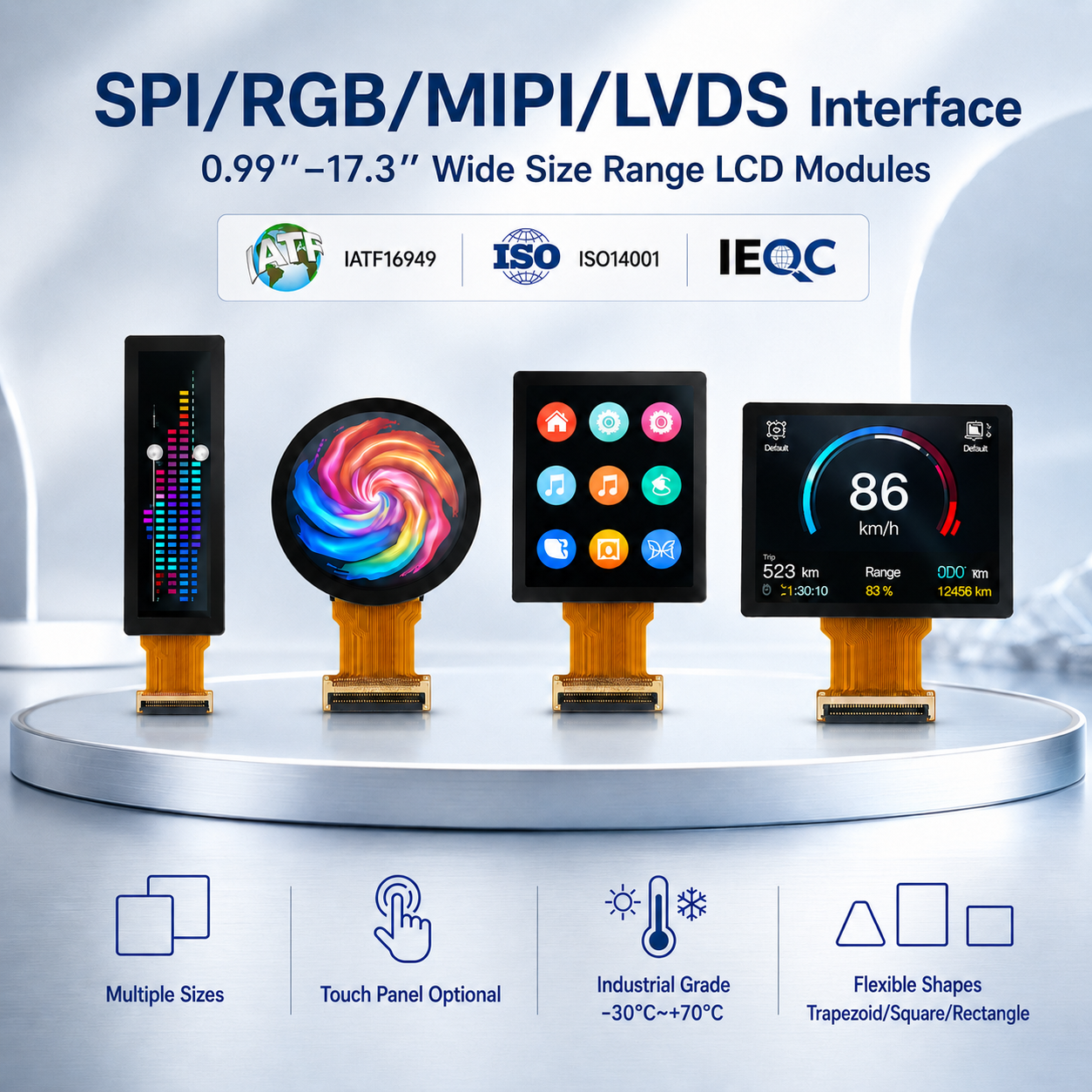
Examining TFT display specs reveals clear superiority over traditional display technologies. Modern TFT modules offer resolutions ranging from 128 by 115 for compact 0.99-inch panels up to 1920 by 1080 for 15.6-inch displays, providing pixel densities suitable for both simple alphanumeric readouts and detailed graphical interfaces. Brightness levels span from 230 to 2500 candelas per square meter, with sunlight-readable variants available for outdoor applications. Operating temperature ranges typically extend from minus 30 to 80 degrees Celsius, with industrial-grade modules rated for minus 40 to 85 degrees Celsius. These TFT display specs far exceed the capabilities of passive-matrix LCDs, which generally offer lower contrast ratios, narrower viewing angles, and limited brightness output. Interface options including MIPI, RGB, SPI, LVDS, and eDP provide flexible integration paths for various host processor architectures, and the TFT display advantages in brightness and resolution enable deployment in conditions where traditional displays would fail.
High-resolution TFT displays have transformed vehicle cabin design, replacing traditional mechanical gauges with configurable digital clusters. In a representative automotive application case, a vehicle manufacturer required a display module capable of maintaining visual clarity under direct sunlight exposure while operating across extreme temperature fluctuations. By selecting a TFT module with 1000 candelas per square meter brightness and an operating range of minus 40 to 85 degrees Celsius, the manufacturer achieved reliable performance in both desert and arctic conditions. The active-matrix display benefits ensured that fast-moving graphical content, such as navigation maps and real-time vehicle diagnostics, rendered without ghosting or lag. Industrial control applications similarly benefit from TFT technology, where operators rely on crisp, high-contrast displays for monitoring complex process parameters in manufacturing environments.
When assessing suppliers for TFT display modules, procurement teams should verify several critical capabilities. First, confirm that the manufacturer maintains recognized quality certifications such as ISO 9001, ISO 14001, and IATF 16949 for automotive applications. Second, evaluate the supplier's manufacturing infrastructure, including automated COG and FOG bonding lines, optical bonding capability, and comprehensive functional testing processes. Third, assess customization capabilities, as many applications require non-standard sizes, specialized backlight designs, or unique interface configurations. A vertically integrated manufacturer with in-house glass cutting, bonding, backlight design, and module assembly can offer shorter development cycles and more consistent quality. The TFT display advantages in terms of performance are only fully realized when the manufacturing partner maintains rigorous process controls throughout production, and verifying high-resolution TFT displays quality through reliability testing is essential before committing to volume orders.
Q: What Are the Main TFT Display Advantages Over Passive-Matrix LCD
A: The primary TFT display advantages include significantly faster pixel response times, higher contrast ratios, wider viewing angles, and superior color reproduction. Active-matrix display benefits also include better image stability during rapid content changes, reduced ghosting, and the ability to support higher resolutions. These advantages make TFT technology the preferred choice for applications requiring detailed graphical interfaces, video playback, or operation in challenging lighting conditions where traditional displays cannot perform adequately.
Q: How Do TFT Display Specs Compare Between Consumer and Industrial Grade
A: Industrial-grade TFT display specs typically feature wider operating temperature ranges from minus 30 to 85 degrees Celsius or broader, higher brightness options up to 2500 candelas per square meter, and more robust mechanical construction compared to consumer-grade modules. Industrial TFT displays also offer extended product life cycles exceeding five years, ensuring long-term availability for sustained production runs. Interface flexibility with MIPI, LVDS, SPI, RGB, and eDP options supports diverse integration requirements across industrial and automotive platforms, making high-resolution TFT displays suitable for mission-critical environments.
Q: What Should Buyers Check When Sourcing High-Resolution TFT Displays
A: Buyers sourcing high-resolution TFT displays should verify the supplier's quality certifications, manufacturing automation level, customization capabilities, and testing protocols. Request reliability test data including temperature cycling, humidity resistance, and vibration testing results. Confirm that the manufacturer can provide consistent product life cycle support and technical documentation. Evaluate whether the supplier offers optical bonding for enhanced sunlight readability and whether their production capacity can scale with projected demand volumes, as these factors directly impact the TFT display advantages realized in the final application.