EN
EN

Why ips display is favored for high end automotive display systems
2026/07/10
2026/07/06
When procurement teams in the automotive, industrial control, and smart home sectors evaluate display components, one recurring frustration is clear: standard off-the-shelf TFT displays make it increasingly difficult to create products that stand out. In markets where dozens of brands source from the same panel suppliers, the end product's visual identity often becomes indistinguishable from competitors. A custom tft display changes this dynamic by enabling OEMs to create a hardware-level differentiator that cannot be easily replicated using generic components. This article examines how custom tft display solutions support differentiated market positioning and what procurement professionals should consider when evaluating customization opportunities.
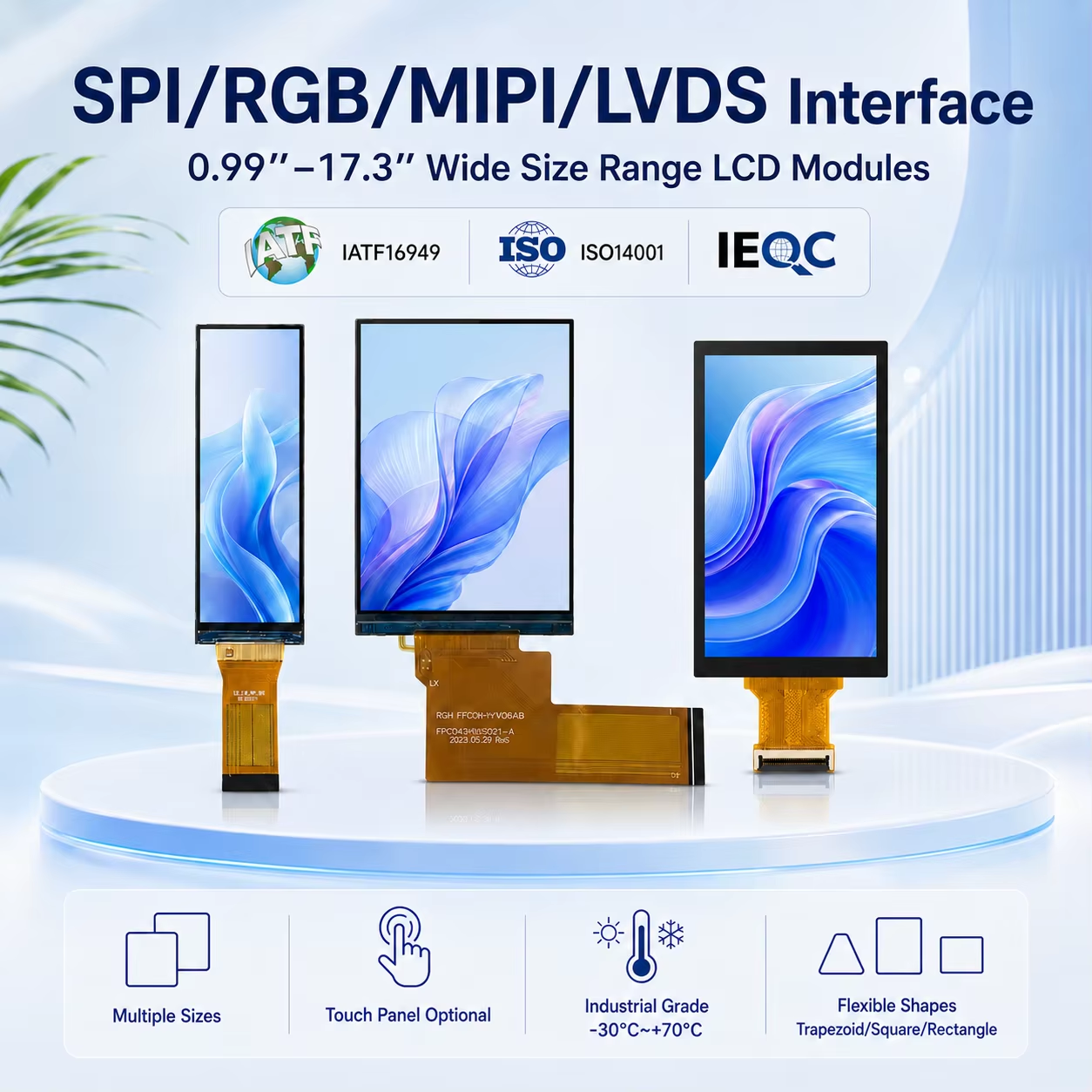
A custom tft display is not simply a standard panel cut to a different size. It is a complete display solution where multiple technical parameters are optimized for a specific end product. These include the outline dimensions, active area size, resolution, brightness level, viewing angle, and the electrical interface, which may be MIPI, SPI, RGB, LVDS, EDP, or MCU depending on the host system architecture. Optical treatments such as anti-glare coatings, anti-fingerprint surfaces, and high-brightness backlight modules can also be customized. For automotive dashboard applications, operating temperature range is often a critical requirement, with many projects demanding reliable performance from minus 30 degrees Celsius to 80 degrees Celsius. The lcd display module must function consistently across this range without degradation in response time, contrast, or color accuracy.
The most impactful customization parameters for a tft display fall into four categories. Mechanical customization covers the physical outline dimensions, mounting hole positions, and connector placement, allowing the display to fit seamlessly into a product's industrial design envelope. Optical customization includes brightness levels from standard 300-nit indoor panels to 1000-nit or higher sunlight-readable displays, contrast ratios, color gamut coverage, and viewing angle optimization using IPS or other wide viewing angle technologies. Electrical customization determines which interface protocol drives the display and whether capacitive touch, resistive touch, or no touch functionality is integrated. Environmental customization addresses operating temperature range, humidity resistance, shock and vibration tolerance, and compliance with specific industry standards. A well-designed custom lcd display optimizes these parameters as an integrated system rather than accepting off-the-shelf compromises.
When an OEM ships a product with a uniquely designed display solution, this creates meaningful barriers to direct comparison by end customers. A smart home control panel with a custom aspect ratio and high-brightness tft display cannot be directly compared to a competitor's product using a standard 7-inch 1024 by 600 module because the visual experience is fundamentally different. In industrial HMI applications, a custom display with optimized touch performance under gloved operation and wide viewing angles creates tangible workflow advantages. In automotive instrument clusters, a curved or shaped tft display that follows the dashboard contour communicates design sophistication that standard rectangular panels cannot achieve. These hardware-level differentiators translate into premium product positioning and stronger brand recognition in increasingly crowded markets.
A European smart home OEM found that their wall-mounted control panel looked almost identical to three competing products on retail shelves, as all four used the same standard 7-inch tft display module. The OEM's engineering team partnered with a display manufacturer to develop a custom solution with a wider aspect ratio, 1000-nit brightness for visibility in sunlit living spaces, and an optically bonded cover glass with anti-fingerprint coating. The tooling investment was recovered within the first production batch, and the OEM reported a measurable improvement in retail shelf differentiation along with a substantial decline in customer returns related to display readability. The manufacturing partner, which had completed over 10,000 design projects and operated a production base exceeding 120,000 square meters, provided full reliability testing documentation for every sample batch and a 12-month warranty. The experience demonstrated that a custom tft display project, supported by a manufacturer with proven design and production capabilities, can deliver tangible market positioning advantages even for mid-volume smart home products.
Selecting a supplier for a custom tft display project requires a different evaluation framework than sourcing standard panels. Procurement teams should assess the supplier's design track record, including the number of completed custom projects and the diversity of industries served. In-house manufacturing capabilities are equally important; facilities that control the full process from precision glass cutting through COG, FOG, and FOB bonding, optical bonding, customized backlight design, and module assembly can maintain tighter quality control and shorter lead times than those that outsource critical steps. Quality certifications such as ISO 9001, ISO 14001, and IATF 16949 for automotive applications provide documented evidence of process maturity. Sample evaluation protocols should include reliability testing under actual operating conditions, not only ambient room temperature. A comprehensive evaluation should also verify that the supplier uses ERP and MES systems for traceability and process control.
The decision between custom and standard tft display modules ultimately rests on market positioning strategy rather than component cost alone. A standard display may reduce upfront engineering expense, but it also limits the product's ability to command a differentiated market position. When competitors use the same display panel, unit price becomes the primary comparison dimension for end customers. A custom lcd display creates a unique product identity that supports premium pricing, stronger brand loyalty, and longer product life cycles. The feasibility of custom TFT display projects has improved significantly; manufacturers with mature custom capabilities can now support moderate production volumes with competitive per-unit costs, making custom tft display projects accessible to mid-sized industrial and smart home OEMs as well as automotive Tier 1 suppliers.
What is the minimum order quantity for a custom tft display project? Minimum order quantities vary based on customization complexity and display size, but for modules in the 3-inch to 10-inch range, typical annual MOQs range from 3,000 to 10,000 units. One-time tooling costs for custom mechanical parts, backlight molds, and cover glass are separate from per-unit pricing and should be clarified during the initial design review.
How long does a custom tft display development project typically take? A typical timeline ranges from 8 to 16 weeks from design freeze to delivery of reliability-tested samples. This includes mechanical design review, optical specification confirmation, prototype tooling fabrication, sample production, and full reliability testing. Projects requiring optical bonding or automotive-grade certifications may need additional qualification time.
What certifications should I look for when evaluating a custom tft display supplier? At minimum, verify ISO 9001 for quality management and ISO 14001 for environmental management. For automotive applications, IATF 16949 is essential. IECQ certification provides additional assurance for electronic components. The supplier should also provide RoHS compliance documentation and full reliability test reports for each sample batch.
Standard vs Custom TFT Display: Key Differences for OEM Product Development
|
Comparison Dimension |
Standard TFT Display |
Custom TFT Display |
|
Outline dimensions |
Fixed to supplier catalog sizes |
Optimized for product industrial design |
|
Brightness |
Standard 250-400 nit |
Custom 300-1500+ nit for target environment |
|
Interface type |
Limited to supplier's standard offering |
Selectable from MIPI, SPI, RGB, LVDS, EDP, MCU |
|
Touch integration |
Limited pre-configured options |
Custom capacitive or resistive touch with cover glass |
|
Viewing angle |
Standard bias direction |
IPS wide viewing angle or custom bias |
|
Operating temperature |
Standard 0 to 50 degrees Celsius |
Extended range including minus 30 to 80 degrees Celsius |
|
Optical bonding |
Rarely available as standard |
Available with anti-glare treatments |
|
Product differentiation |
Same display as competitors |
Unique hardware-level visual identity |
|
Minimum order quantity |
Low, often no minimum |
Typically 3,000-10,000 units per year |
|
Tooling investment |
None |
One-time molding and fixture cost |