EN
EN

Why ips display is favored for high end automotive display systems
2026/07/10
2026/08/06
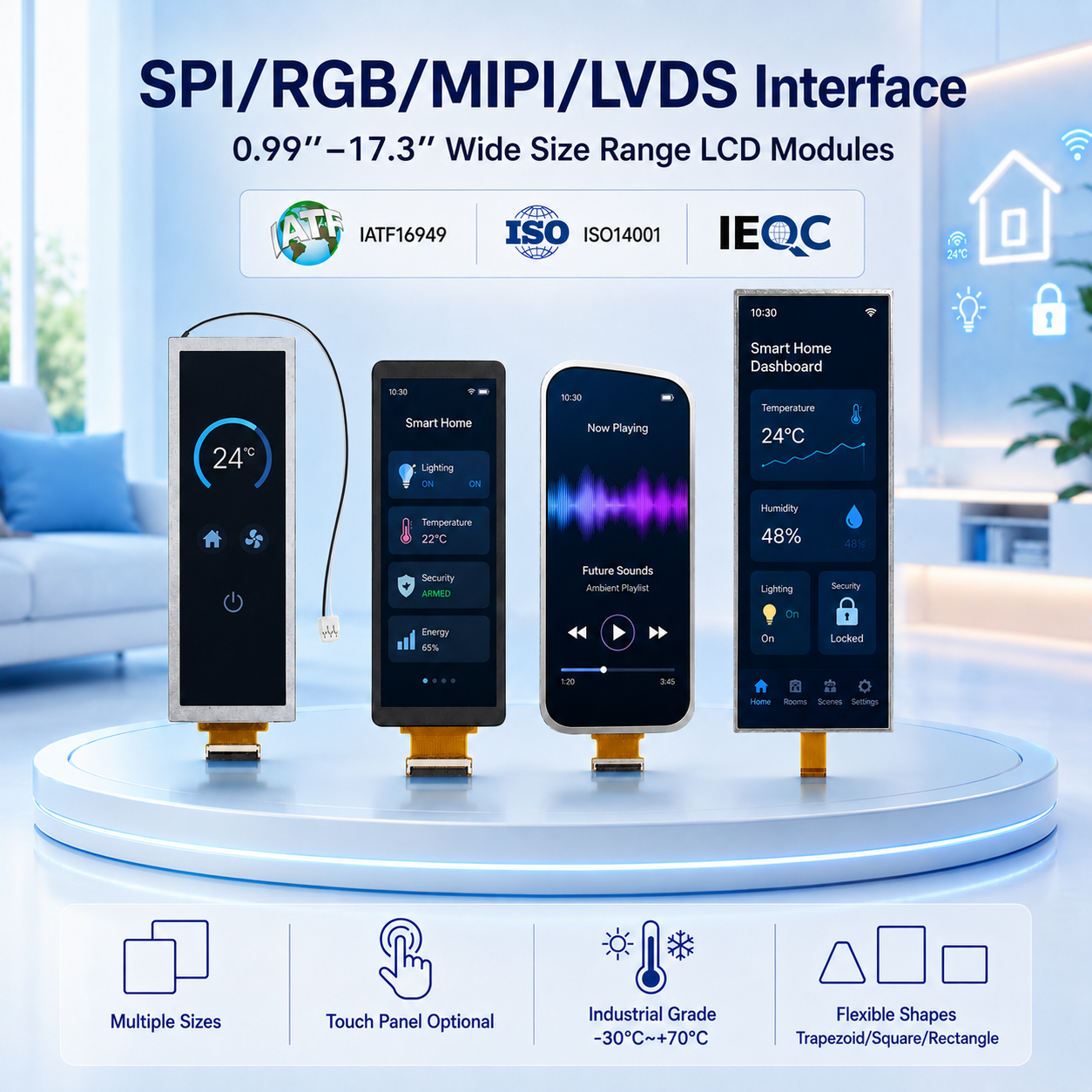
Every procurement decision involving a TFT LCD display module is fundamentally a balance between technical ambition and real-world budget constraints. Engineering teams usually dream of maximum brightness, razor-sharp resolution, and ultra-wide viewing angles. Meanwhile, finance teams remain focused on unit pricing, minimum order quantities, and predictable lifecycle expenses.
The good news is that modern display manufacturing has reached a high level of maturity. Standardized interfaces and massive economies of scale have created a sweet spot where high reliability does not require a massive price tag. Achieving effective display cost optimization comes down to knowing which cost drivers matter for a specific product and which specifications just burn money without adding value.
The most expensive part of any TFT LCD display is the glass substrate and the associated thin-film transistor array fabrication process. Massive manufacturing facilities process giant mother glass sheets, slicing them into individual panels.
When a module size aligns neatly with these mother glass dimensions, the panel yield goes up and unit costs drop significantly.
This efficiency explains why screen sizes between 7 inches and 10.1 inches offer some of the strongest cost performance balance metrics in the hardware world. Moving outside these high-volume sizes—such as choosing a custom round screen for wearables or an unusual screen size for specialty kiosks—drops substrate utilization efficiency. Smart LCD module procurement always starts with knowing where a desired size falls on the global manufacturing efficiency curve.
Interface selection serves as a powerful lever for controlling costs without sacrificing performance. Different applications call for different bandwidth capacities, and matching the interface to the actual resolution saves substantial hardware budget:
RGB and SPI Interfaces: Perfect for economical designs. They handle screens up to 4.3 inches with WVGA resolutions smoothly while keeping controller chip costs minimal.
LVDS and MIPI DSI: Ideal for mid-sized screens (5 to 10 inches) needing Full HD visuals. They balance high bandwidth with moderate component costs.
eDP (Embedded DisplayPort): Reserved for high-end, ultra-high-resolution setups, carrying the highest interface IC costs.
Selecting an unnecessarily complex interface adds expense without improving visual quality. For example, a standard 4.3-inch TFT LCD display on an industrial control panel does not require an LVDS setup. Opting for a standard RGB setup can slash bill-of-materials costs by 15% to 20% while displaying identical graphics.
Integrating touch functionality is another area where design choices dramatically shape total module expenses. Hardware teams generally choose between two primary touch structures:
| Touch Integration Type | Supply Chain Impact | Cost & Volume Flexibility | Ideal Application |
| Discrete Capacitive Touch | Separate glass layer; easier component swapping | Low MOQs; flexible component sourcing | Mid-volume industrial products (5,000–20,000 units) |
| On-Cell / In-Cell Touch | Integrated directly into the cell; thinner profile | High initial tooling; demands high MOQs | Mass-market consumer electronics & smartphones |
For mid-volume production runs, discrete touch assemblies offer a practical balance between physical durability and supply chain resilience. Sourcing touch controllers independently protects production schedules from single-supplier bottlenecks.
Customizing the backlight offers immediate opportunities for display cost optimization. A standard TFT LCD display backlight offering 400 to 500 nits is more than bright enough for indoor equipment. Yet, many technical requirements call for 1,000 nits "just in case."
High-brightness backlights demand more LEDs, higher power consumption, and bulkier thermal management setups, all of which drive up expenses. The same logic applies to operating temperature ranges. Designing for extreme temperatures requires specialized LED bins and thermally compensated driver ICs. Conducting realistic environmental tests early in the design phase prevents over-engineering and keeps unit costs in check.
A real-world example highlights how practical analysis pays off. A smart home device manufacturer originally specified a 4.3-inch TFT LCD display featuring an IPS panel, 1,000 nits brightness, and an LVDS interface for a wall-mounted indoor thermostat.
Recognizing that the device operates strictly indoors away from direct sunlight, the engineering team adjusted the specification during LCD module procurement. They lowered the brightness target to 500 nits and switched the interface to RGB.
These adjustments reduced module costs by nearly 28% without impacting visible screen quality. The savings were redirected toward an advanced capacitive touch controller with gesture support, boosting actual user engagement where it mattered most.
While cost reduction is critical, cutting corners on environmental durability introduces major long-term risks. Standard commercial screens rated for basic indoor temperatures fail quickly when exposed to outdoor elements or unheated industrial facilities.
Upgrading to industrial-grade components—such as wide-temperature polarizers, resilient LED backlights, and optically clear adhesives (OCA)—typically adds 15% to 25% to the initial hardware price. However, this investment protects against premature field failures, costly warranty claims, and brand reputation damage that far outweigh upfront savings.
Not necessarily. While twisted nematic (TN) panels feature low raw glass costs, high-volume production has narrowed the price gap between TN and IPS technologies in 5-inch to 7-inch sizes. Choosing IPS early prevents expensive hardware redesigns later if wider viewing angles become necessary.
Unit pricing follows clear volume steps:
1 to 500 units: Setup and NRE tooling fees drive higher per-unit costs.
500 to 5,000 units: Material costs spread out, bringing steady savings.
5,000+ units: Full economies of scale kick in across raw materials and automated assembly lines.
Beyond unit prices, factor in one-time engineering (NRE) fees for custom flex cables, specialized protective packaging for transit, incoming quality control testing, and buffer stock maintenance. Working with certified production lines prevents unexpected failure rates during final assembly.
Navigating the trade-offs between component cost, visual performance, and long-term supply chain reliability requires direct communication with experienced display manufacturers. Partnering with vertically integrated facilities—where surface-mount technology (SMT), COG/FOG bonding, and custom backlight assembly occur under one roof—ensures full transparency across the production cycle.
Established manufacturing partners like Weitai Technology help streamline TFT manufacturing workflows, delivering flexible custom designs, robust quality control, and dependable supply management tailored for global deployments. Learn more about custom display solutions and engineering support at