EN
EN

Why ips display is favored for high end automotive display systems
2026/07/10
2026/08/07
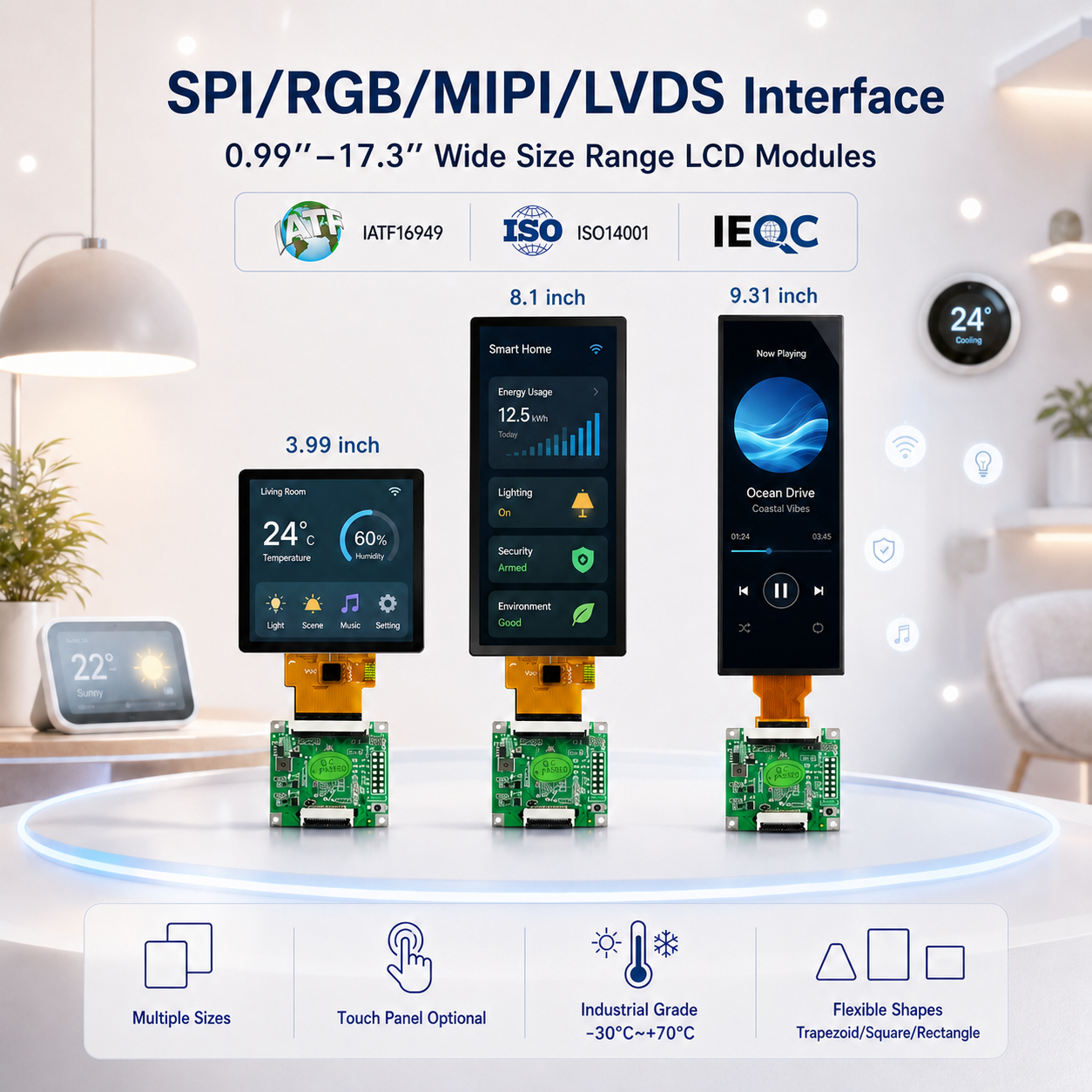
When a fresh shipment of display modules arrives at the receiving dock, the incoming inspection process determines whether those panels will integrate seamlessly into final assembly lines or trigger costly production delays. Evaluating a fully integrated touch screen display involves much more than inspecting raw components. It requires a systematic display performance test protocol that validates optical clarity, touch responsiveness, electrical stability, and physical durability.
Establishing a rigorous LCD quality assurance workflow serves two vital goals: it verifies supplier compliance and protects your end products from field returns down the line.
Optical verification forms the bedrock of display evaluation. Before taking measurements, allow the panel to run for 30 minutes so the backlight reaches thermal equilibrium.
Key optical metrics evaluated during inspection include:
Luminance and Uniformity: Measured in cd/m² across a nine-point grid. Industrial panels typically require brightness uniformity above 75%.
Contrast Ratio: Calculated by comparing white-state luminance against black-state luminance under controlled lighting conditions under 1 lux.
Color Accuracy: Evaluated via Delta E values using a spectroradiometer. A Delta E under 3 fits general industrial uses, while medical or color-critical equipment requires a Delta E under 2.
Consistent optical measurements depend heavily on letting backlights warm up properly. Testing cold panels leads to inaccurate color and brightness readings.
Touch capability adds another layer of testing complexity, as physical accuracy relies on tight cooperation between controller firmware, sensor patterns, and cover glass thickness.
| Testing Parameter | Pass Threshold | Primary Equipment Used |
| Linearity Error | < 1.5 mm across sensor grid | Precision robotic touch finger |
| Position Jitter | < 0.5 mm at fixed point | Automated coordinate logger |
| Touch Response Time | < 20 ms from contact to signal | High-speed optical/electrical logger |
| Multi-Touch Tracking | Zero point merging or coordinate swap | Multi-axis touch actuator |
Executing multi-point touch accuracy testing with an automated touch robot provides objective, repeatable data across hundreds of test points, ruling out human operator error.
A comprehensive display reliability test plan must cover electrical performance, power draw, and noise immunity.
Current consumption should be verified across all operating states—from standby modes to maximum brightness settings—and benchmarked against official engineering datasheets.
Following IEC 61000-4-2 standards, panels undergo contact discharges up to 8kV and air discharges up to 15kV. Test points include cover glass edges, outer bezels, and flex cable connectors. The module must maintain stable touch coordinates without latching up or showing screen artifacts.
Emissions testing confirms that high-frequency switching noise from backlight drivers and touch controllers won't disrupt nearby wireless modules or sensitive analog sensors.
Environmental testing proves whether a touch screen display can endure tough field conditions without degrading over time.
High-Temperature Storage: Exposing modules to 85°C for 240 hours catches premature polarizer degradation, optical adhesive yellowing, and backlight efficiency loss.
Thermal Cycling: Cycling between -30°C and 80°C tests layer bonding. After 100 cycles, the optical stack must show zero delamination or loss in touch precision.
Damp Heat Exposure: Running panels at 85°C and 85% relative humidity for 500 hours highlights weaknesses in edge seals and connector corrosion resistance.
A practical case from an industrial tablet manufacturer shows why detailed incoming testing matters. The receiving team took delivery of a 10.1-inch panel batch that easily passed visual checks on the dock.
However, during automated touch accuracy testing, the robot flagged a 2.8 mm linearity error near the bottom corner—well beyond the 1.5 mm pass limit.
Further analysis revealed that the touch sensor FPC had shifted slightly during bonding, displacing the sensor pattern relative to the active display area. Because the error was isolated to a corner rarely used in manual spot checks, basic testing missed it. The batch was rejected, allowing the supplier to realign their bonding fixtures before replacement units were shipped.
Manual checks work for quick functional passes, but they lack consistency. Human testers cannot apply identical force or hit sub-millimeter coordinates repeatedly across hundreds of points. Automated touch robots provide the objective data needed for true statistical process control.
For initial sample reviews, executing a full display performance test protocol on 20 to 32 samples provides strong baseline data. For ongoing production lots, sampling 5 to 8 units focusing on optical and touch parameters works well. If a sample fails, double the test sample size for that lot.
Noise coupling through flexible printed circuits (FPCs) is often missed. High-frequency noise from touch controllers can pass into host electronics, interfering with sensitive analog circuits or GPS receivers. Checking power rail noise levels while running continuous touch scans prevents surprising board-level issues.
Maintaining high yield rates requires working with manufacturing partners who prioritize robust LCD quality assurance throughout the production process. Factory-direct suppliers operating under certified quality management systems run comprehensive display reliability test programs on every shipment, backing performance with transparent inspection reports.
Leading manufacturers like Weitai Technology bring advanced optical test labs, automated touch calibration equipment, and vertically integrated SMT assembly to custom display projects. Partnering with Weitai ensures full supply chain visibility, reliable quality controls, and long-term hardware support for global B2B deployments. Explore custom display capabilities at