EN
EN
Why ips display is favored for high end automotive display systems
2026/07/10
2026/07/24
Why Production Standards Matter for TFT Display Buyers
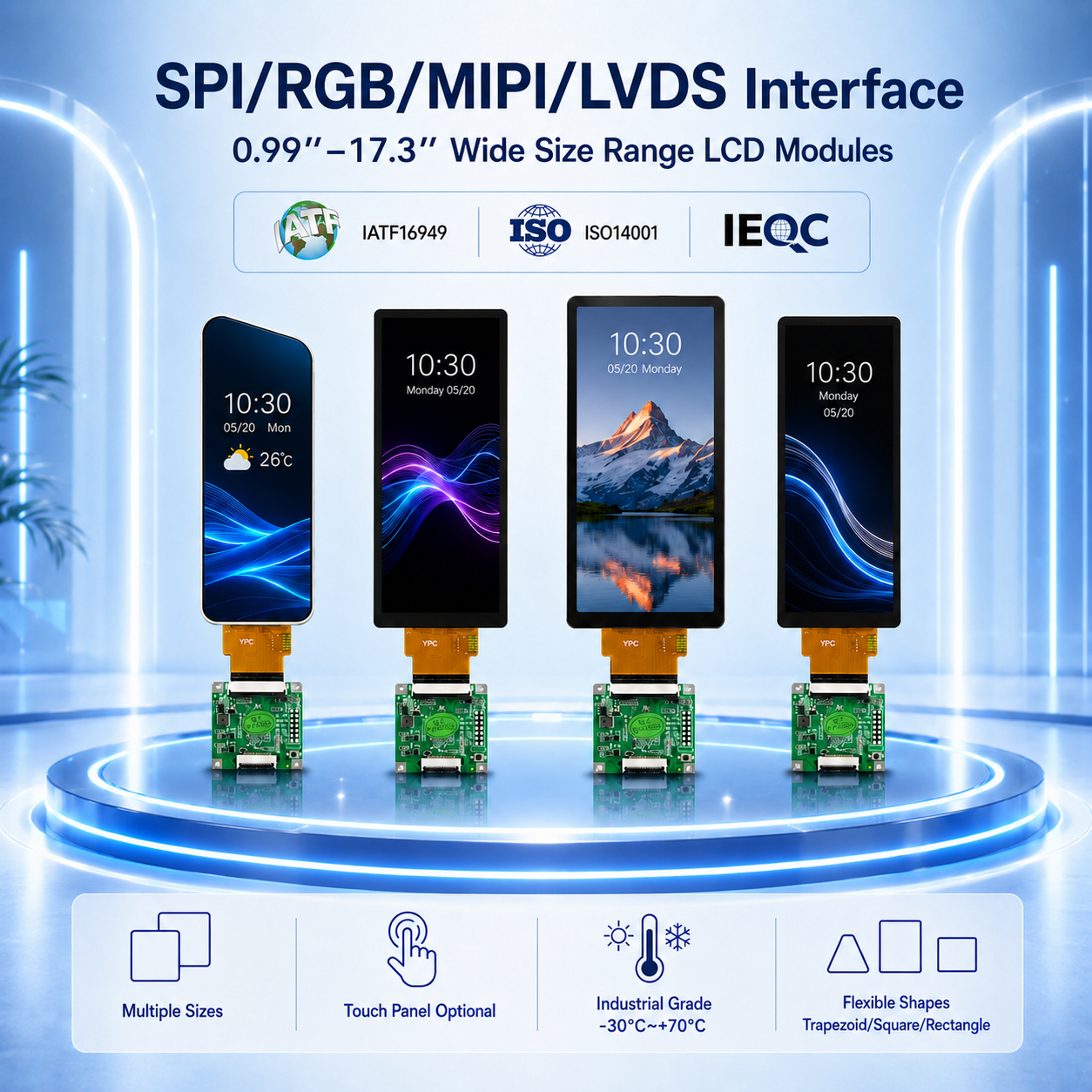
When sourcing a tft display for industrial, automotive, or consumer applications, production standards are the foundation that determines whether the product will perform reliably in the field. A tft display is not a commodity item; it involves thin-film transistor technology, precise glass substrates, driver IC integration, and optical bonding processes that require strict quality management. Top tft display factories adhere to internationally recognized standards such as IATF 16949 for automotive quality, ISO 9001 for general quality management, and ISO 14001 for environmental management. In our five years of auditing tft display suppliers across Asia, we have found that factories maintaining these certifications consistently deliver lower defect rates, better traceability, and more stable tft display supply compared to uncertified competitors.
IATF 16949: The Gold Standard for Automotive TFT Display Manufacturing
IATF 16949 is the automotive industry quality management standard developed by the International Automotive Task Force. For a tft display factory supplying automotive applications such as instrument clusters, infotainment screens, or rear-seat entertainment, IATF 16949 certification is essentially mandatory. This standard requires the factory to implement Advanced Product Quality Planning, Production Part Approval Process, Failure Mode and Effects Analysis, and statistical process control across all tft display production stages. A factory certified to IATF 16949 must demonstrate that every tft display produced meets documented specifications, with real-time monitoring of critical parameters such as cell gap, luminance, and color uniformity. Buyers should request the IATF certificate number and verify it through the IATF Oversight website, as some suppliers present expired or fraudulent certificates.
ISO 9001 and ISO 14001: Foundational Standards for TFT Display Quality
ISO 9001 provides the general quality management framework that every reputable tft display factory should hold. It requires documented procedures for design control, supplier management, production process control, inspection and testing, corrective action, and continuous improvement. For a tft display, this means the factory must maintain process flow documents, control plans, and inspection records for each production stage, from glass cleaning to final module testing. ISO 14001 addresses environmental management, ensuring the tft display factory controls chemical waste from etching and cleaning processes, manages energy consumption, and complies with RoHS and REACH regulations. Buyers sourcing tft display products for the European market should specifically confirm RoHS compliance, as non-compliant tft display shipments may be rejected at customs.
Reliability Testing Standards for TFT Display Products
Beyond management system certifications, top tft display factories follow specific reliability testing standards to validate product durability. These typically include thermal cycling tests from minus 30 to 80 degrees Celsius, high-temperature storage at 70 degrees Celsius for 240 hours, low-temperature storage at minus 40 degrees Celsius for 240 hours, and damp heat testing at 60 degrees Celsius and 90 percent relative humidity for 96 hours. For automotive tft display products, vibration testing and mechanical shock testing are also required. A professional tft display factory will generate a reliability test report for each new product, and buyers should request these reports during the qualification process. In our experience, tft display failures in the field most often trace back to insufficient reliability testing during the development phase.
MES and ERP Systems: Digital Standards for TFT Display Production
Modern tft display factories increasingly rely on Manufacturing Execution Systems and Enterprise Resource Planning systems as production standards. An MES monitors every tft display on the production line in real time, recording bonding parameters, inspection results, and operator actions. This digital trail enables complete traceability: if a tft display fails in the field, the factory can identify the exact production date, shift, equipment, and material batch involved. ERP systems ensure that raw materials, especially LCD glass substrates and driver ICs, are procured from qualified suppliers with appropriate lead times to prevent tft display production delays. Buyers should ask whether the factory uses MES and ERP systems, as this is a strong indicator of production discipline and data-driven quality management for tft display manufacturing.
How to Verify a TFT Display Factory's Compliance with Standards
Verifying a tft display factory's claimed standards requires a systematic approach. First, request copies of all certification certificates and check their validity dates and scope. Second, ask for the most recent third-party audit report, which will reveal any nonconformities found during the audit. Third, request a virtual factory tour to observe whether documented procedures are actually followed on the tft display production floor. Fourth, ask for sample quality records, including inspection reports, control charts, and reliability test data for a tft display product similar to what you plan to order. Fifth, request references from other customers, particularly those in the same industry or region. Factories like Hunan Weitai Technology, which holds IATF 16949, ISO 9001, and ISO 14001 certifications with a 120,000-square-meter facility and over 90 patents, represent the type of supplier that meets these production standards consistently.
Practical Scenario: Qualifying a TFT Display Supplier for Medical Equipment
A medical device manufacturer in North America needed a 5.98-inch tft display for a portable diagnostic device. They evaluated three suppliers, all claiming IATF 16949 and ISO 9001 certification. During the qualification process, they discovered that one supplier's IATF certificate had expired six months earlier, and another could not provide reliability test reports for their tft display products. Only the third supplier, an automated factory with MES-tracked production lines and complete documentation, passed the full qualification audit. The tft display from this supplier achieved zero field failures across 20,000 units shipped over 12 months, validating the importance of verifying production standards rather than accepting certificates at face value.
Frequently Asked Questions
Q: What is the most important certification for a tft display factory?
A: For automotive tft display applications, IATF 16949 is the most critical certification. For general industrial and consumer tft display products, ISO 9001 is the minimum requirement. ISO 14001 demonstrates environmental responsibility and RoHS compliance capability.
Q: How can I check if a tft display factory's IATF 16949 certificate is valid?
A: Request the certificate number and the certification body name. You can verify IATF 16949 certificates through the certification body's website or the IATF Oversight Office. Always check the expiration date and confirm that the scope includes tft display manufacturing.
Q: What reliability tests should a tft display pass before mass production?
A: A tft display should pass thermal cycling, high-temperature storage, low-temperature storage, damp heat testing, and for automotive applications, vibration and mechanical shock testing. Request the full reliability test report before approving a tft display for mass production.