EN
EN

Why ips display is favored for high end automotive display systems
2026/07/10
2026/08/01
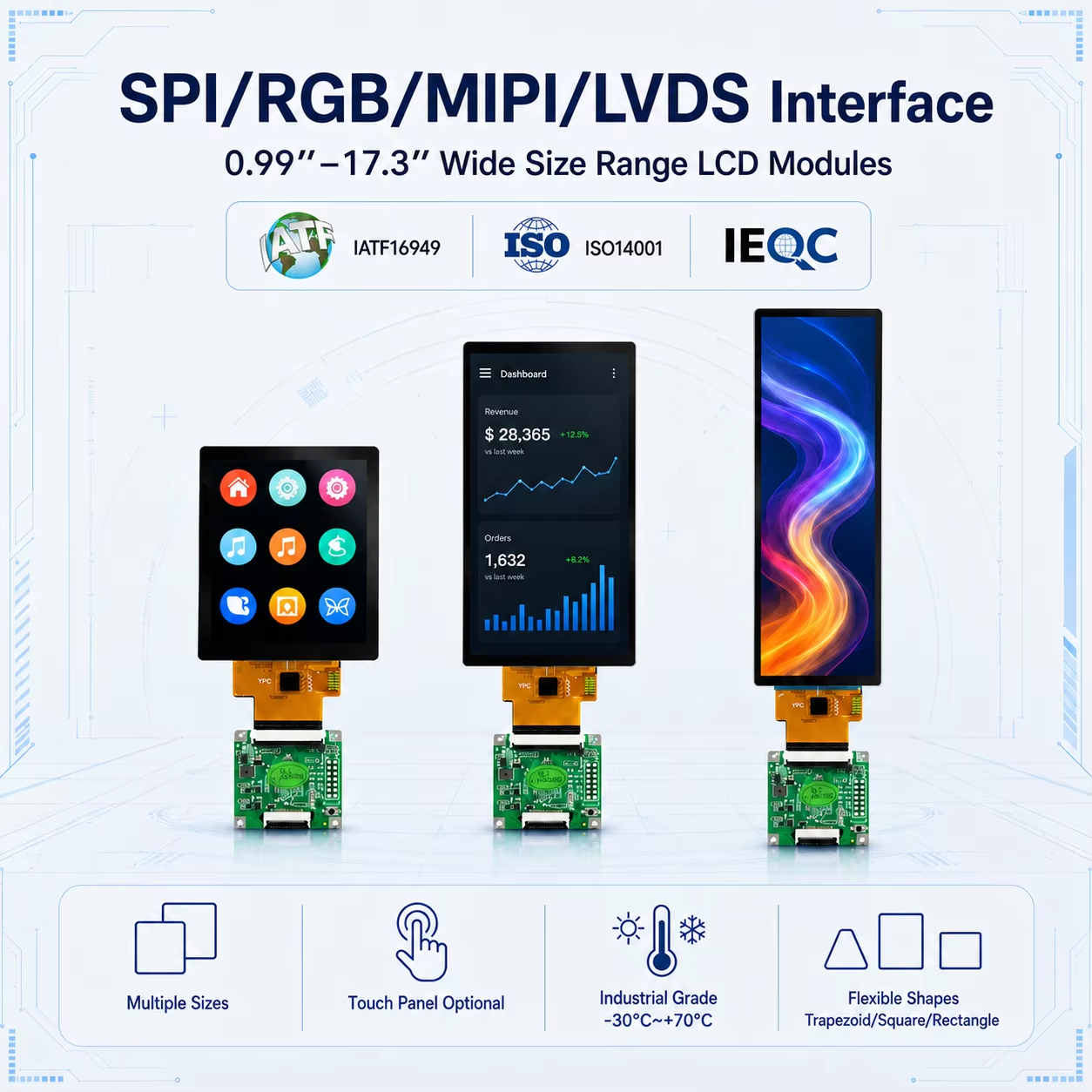
Walk into the cab of any commercial vehicle, and you will immediately notice the strict spatial constraints. Unlike passenger cars with standardized dashboard bays, commercial trucks, buses, and specialized vehicles present unique mounting challenges that off-the-shelf screens simply cannot solve. Over the years, engineering teams have designed custom car display solutions for logging trucks in Canada, city buses in India, and refrigerated delivery vans in Australia. In every single case, a specialized custom display size was not a luxury, but an absolute necessity for proper vehicle integration.
Commercial vehicle dashboards differ dramatically from passenger car interiors. A long-haul truck dashboard often features a narrow horizontal slot that fits a compact car display perfectly, yet it cannot accommodate the bulky 10.1-inch tablet-sized screens common in passenger vehicles. Similarly, a bus driver console might require an elongated commercial vehicle screen with an unusual aspect ratio to display vital route information right alongside live CCTV feeds.
Forcing standard display sizes into these spaces often forces vehicle designers to modify entire dashboard structures, adding unnecessary tooling costs and severely compromising ergonomics. A custom fleet display module eliminates these compromises by fitting precisely into available spaces. Instead of looking like an awkward add-on, the screen becomes a fully integrated part of the interior architecture. When a major South Korean bus manufacturer needed a unique screen dimension, a standard product could not match their opening. Producing a tailored automotive LCD customization module fit the exact slot, saving weeks of costly dashboard retooling work.
Commercial vehicles frequently demand screens with non-standard aspect ratios. Digital rearview mirrors in heavy trucks require tall, narrow formats like 320x1280 or 400x960. Meanwhile, split-screen bus dashboards showing route maps and passenger surveillance simultaneously benefit greatly from ultra-wide formats like 1920x720. Sourcing these specialized aspect ratios from standard consumer electronics catalogs is virtually impossible.
Advanced automotive LCD customization enables design engineers to specify exact pixel dimensions that match their interface layout, rather than forcing software developers to adapt user interfaces to restrictive screen geometries. This design freedom is particularly valuable for commercial fleet operators who require consistent display layouts across multiple vehicle generations.
Consider a practical scenario: an Australian mining company required a reliable car display for their haul truck fleet that could display both GPS navigation and payload data side by side. Standard 16:9 screens made both data panels far too small to read comfortably at arm's length. By implementing a tailored custom display size, engineers designed a wide commercial vehicle screen that offered enough horizontal space for clear split-screen operation, dramatically boosting operator efficiency and overall safety.
Commercial vehicle operators face intense interaction challenges that differ vastly from standard driving conditions. Truck drivers frequently wear heavy work gloves, bus operators navigate vibrating cabins, and construction vehicle operators constantly deal with dirty, dusty, or wet fingers. A standard consumer screen fails instantly in these scenarios.
Integrating specialized touch technology into a fleet display module solves these operational hurdles. Projected capacitive touch panels equipped with custom sensitivity tuning work reliably even through thick work gloves. Furthermore, optical bonding completely eliminates the internal air gap that typically traps moisture and degrades touch accuracy. For a Russian logging fleet operating in extreme sub-zero conditions, customized car display touch sensitivity was engineered to respond accurately to gloved hands while actively rejecting false touches triggered by snow and ice accumulation.
Tailored automotive LCD customization projects for commercial vehicles frequently extend far beyond physical dimensions into rigorous environmental hardening. Operating temperature ranges can be engineered precisely to match extreme deployment regions. Custom brightness levels ensure optimal legibility for open-cab machinery operating under glaring direct sunlight, while specialized interface protocols match existing vehicle computer architectures without requiring expensive protocol conversion hardware.
During a recent deployment for a Brazilian agricultural equipment manufacturer, engineers customized a high-performance car display featuring 1000-nit brightness for tractor cabs operating under the intense tropical sun, wide-temperature operation for reliable cold morning starts, and a custom flat cable length to securely reach the central vehicle computer mounted far away from the dashboard location. No standard off-the-shelf product could ever meet all these demanding requirements simultaneously.
Many fleet managers incorrectly assume that custom sizing is prohibitively expensive. In reality, when partnering with a vertically integrated manufacturer, producing a tailored custom display size can remain remarkably cost-competitive with standard mass-market products. The secret lies in collaborating with a supplier that directly controls glass cutting, optical bonding, backlight design, and module assembly under one roof.
Custom glass cutting derived directly from standard mother glass panels effectively minimizes material waste. In-house backlight design eliminates the heavy markups typically added by third-party component suppliers. Furthermore, automated chip-on-glass and film-on-glass bonding lines maintain consistent manufacturing quality regardless of custom dimensions. When amortized across a fleet of hundreds of commercial vehicles, custom commercial vehicle screen unit costs frequently fall within a very close margin of standard product pricing.
Minimum production quantities vary depending on the manufacturer. Some vertically integrated factories accept custom orders starting at 1,000 units for specialized glass cutting, while others may require higher volumes to fully justify dedicated tooling investments.
Yes. Specialized fleet display module units sourced from IATF 16949-certified manufacturers undergo the exact same rigorous reliability testing as standard products, including thermal cycling, severe vibration testing, and electrical stress validation.
A typical engineering development cycle follows an evolution from engineering verification tests to design and production verification tests, generally taking approximately 12 to 16 weeks from initial specification to full mass production readiness.
For commercial vehicle manufacturers and fleet operators seeking reliable car display solutions, partnering with an experienced industry leader ensures both superior technical capability and seamless production scalability. Weitaitech maintains advanced automated production lines and extensive expertise in tailored display engineering. By applying rigorous automotive standards to every fleet-specific project, Weitaitech delivers exceptional commercial vehicle screen modules that fit perfectly into complex vehicle architectures while meeting stringent industry demands. Choosing the right manufacturing partner transforms difficult dashboard constraints into a lasting competitive advantage for any commercial vehicle program.