EN
EN

Why ips display is favored for high end automotive display systems
2026/07/10
2026/08/12
Industrial touch terminals operate in extreme conditions that would completely destroy consumer-grade electronics within weeks. Factory floors, outdoor kiosks, mining equipment cabins, and marine control panels subject sensitive hardware to severe temperatures, intense vibration, moisture, and chemical exposure. A rugged tft display has emerged as the go-to technology for these demanding applications, offering an unmatched combination of visual performance, environmental resilience, and long-term cost efficiency. Drawing from years of hands-on experience specifying every industrial LCD module for rugged automation projects across manufacturing, logistics, and energy sectors, industry observations highlight specific traits that make a high-performance tft display indispensable. Understanding these architectural characteristics helps engineering teams select the right touch screen terminal hardware to ensure reliable, uninterrupted performance throughout the entire product lifecycle.
A standard industrial tft display uses thin-film transistor technology to control each individual pixel, providing active matrix addressing that delivers fast response times, sharp contrast ratios, and stable image quality. Unlike older passive-matrix screens, a rugged tft display maintains absolute image integrity under heavy vibration and shock conditions because every pixel is independently driven and latched. This architectural benefit is critical for an industrial touch terminal mounted directly onto heavy machinery, where constant mechanical shaking would normally cause annoying flickering or ghosting. Modern industrial modules achieve rapid response times, wide contrast ratios, and high luminance levels, making them fully readable in both dark factory interiors and bright outdoor daylight.
Industrial environments demand an industrial LCD module capable of operating across extreme thermal boundaries. Standard consumer screens are typically rated for a narrow window, which is completely insufficient for heavy-duty applications. High-end tft display hardware specifies operating ranges extending from negative twenty degrees up to seventy or eighty-five degrees Celsius. At very low temperatures, standard liquid crystal fluids increase in viscosity, causing sluggish response times and ghosting. Rugged modules use specialized low-temp fluids and optimized drive waveforms to maintain responsiveness. At elevated temperatures, the backlight LEDs experience accelerated thermal degradation, requiring advanced heat-sinking and conductive cooling paths integrated directly into the housing of the touch screen terminal.
| Parameter | Consumer Display | Industrial TFT Display | Importance for Rugged Terminals |
| Operating Temp | 0 to 50C | -20 to 70C (or -40 to 85C) | Factory floor thermal variation |
| Brightness | 250-350 cd/m2 | 400-1000 cd/m2 | Readability in bright factory lighting |
| Vibration Resistance | Not specified | 5-20G (IEC 60068) | Heavy machinery-mounted panels |
| MTBF (hours) | 10,000-20,000 | 30,000-50,000+ | Continuous 24/7 factory operation |
| Touch Integration | Optional | PCAP standard | Glove and wet finger operation |
| Ingress Protection | Not rated | IP54-IP67 | Dust and liquid washdown resistance |
The embedded tft display inside any modern industrial touch terminal must integrate seamlessly with touch sensing technology that can survive daily industrial abuse. Projected capacitive touch has become the absolute standard for rugged applications, offering multi-touch support, glove compatibility, and superior optical clarity. Industrial touch sensors utilize much thicker cover glass compared to consumer electronics, providing impact resistance against accidental tool drops and flying debris. For touch screen terminal units deployed in food processing plants or chemical facilities, the cover glass must achieve strict ingress protection ratings, requiring edge-sealing with chemical-resistant gaskets that prevent liquid penetration during high-pressure washdowns.
Optical bonding—the precise process of adhering the touch sensor cover glass directly to the tft display surface using an optically clear adhesive—represents a critical manufacturing milestone for robust hardware. Standard air gaps between a screen and its touch sensor create internal reflections that severely degrade contrast and readability under bright lighting. Optical bonding eliminates these gaps, boosting contrast significantly while reducing surface reflections. More importantly, this bonding technique enhances the mechanical integrity of the entire industrial LCD module, preventing internal condensation in humid climates and distributing mechanical stress evenly across the panel interface for superior impact resistance.
Consider a demanding project involving touch terminals installed on underground mining machinery operating in extreme conditions. The operational environment combined heavy vibration, fluctuating sub-zero and tropical temperatures, high humidity, and constant exposure to hydraulic oil and rock dust. Engineers selected a specialized 10.1-inch rugged tft display featuring high brightness, an extended temperature range, chemical-resistant PCAP touch, and full optical bonding. After nearly two years of continuous operation across an entire machinery fleet, zero screen failures were recorded, completely eliminating costly downtime and massive replacement cycles that plagued previous consumer-grade alternatives.
Industrial installations frequently require long cable runs between the main system controller and the display module. A tft display equipped with Low Voltage Differential Signaling (LVDS) interfaces easily supports cable runs up to several meters without signal degradation, outperforming older parallel configurations. For newer, higher-resolution designs, embedded DisplayPort interfaces offer massive bandwidth while maintaining exceptional signal integrity over moderate distances. Choosing a module with the correct industrial interface early in the design cycle prevents costly redesigns when physical integration challenges emerge during prototype testing phases.
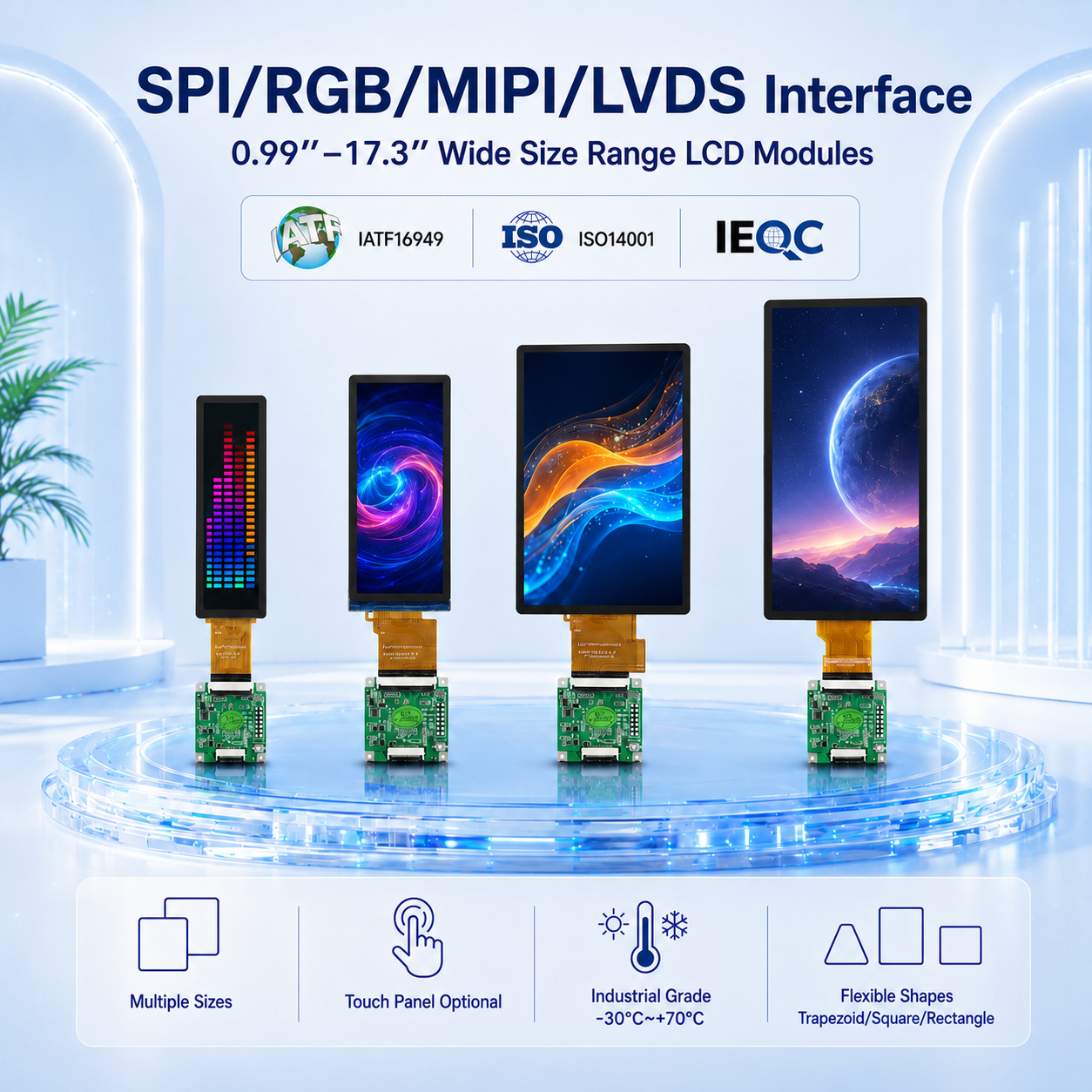
Weitai Technology manufactures high-performance tft display and industrial LCD module solutions featuring wide operating temperature ranges, high-brightness illumination, and fully integrated PCAP touch options. The enterprise's advanced optical bonding production lines support full lamination for any industrial touch terminal requiring high environmental ingress ratings. Backed by IATF 16949 automotive quality certifications and extensive experience supplying major global brands, Weitai applies strict automotive-grade quality controls to every touch screen terminal component, ensuring the extreme reliability that demanding industrial environments demand.